
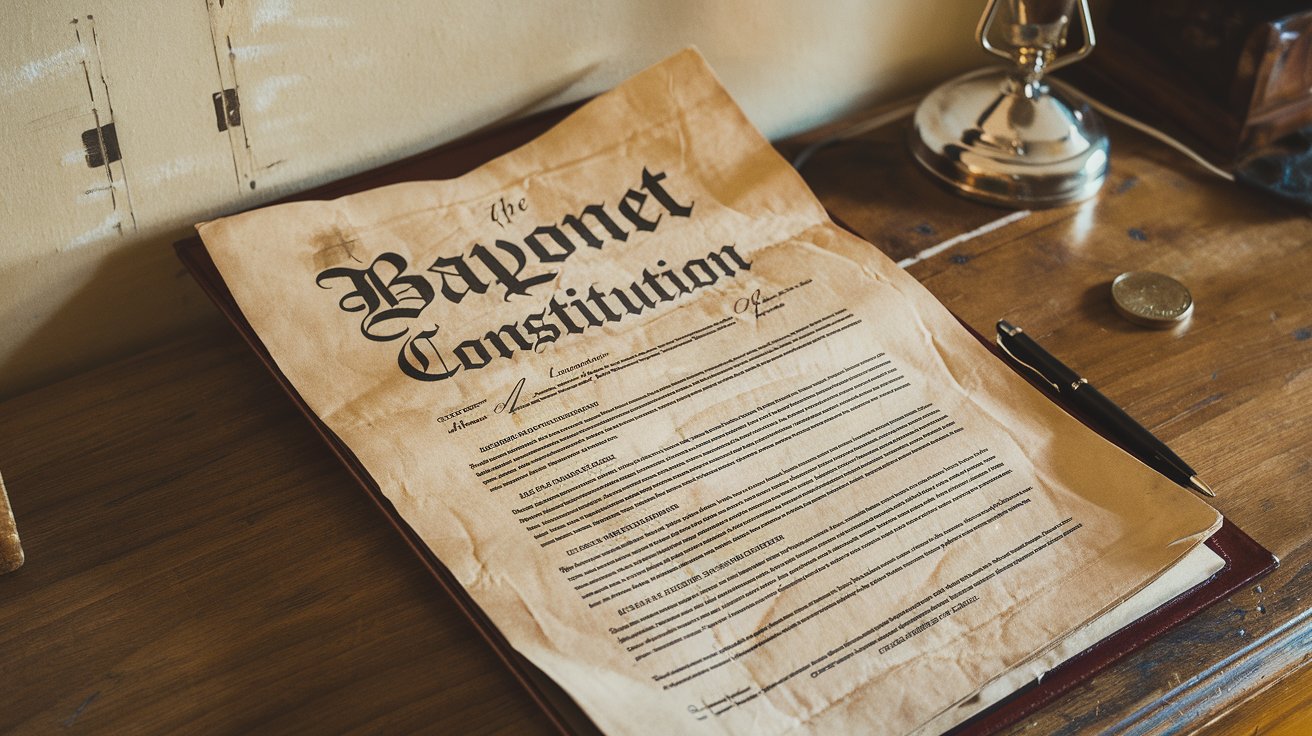
The Bayonet Constitution was a forcibly imposed document signed on July 6, 1887, that dramatically limited the powers of Hawaiian King Kalākaua and disenfranchised most Native Hawaiians and Asian residents. This 1887 Constitution earned its infamous name because King Kalākaua signed it under threat of violence from American and European businessmen backed by armed militia. The document represented a pivotal moment in Hawaiian history that ultimately paved the way for the overthrow of the Hawaiian Kingdom in 1893.
What Did the Bayonet Constitution Do
The Bayonet Constitution fundamentally restructured Hawaiian governance by stripping King Kalākaua of most executive powers and transferring authority to the Cabinet, which no longer required royal approval for decisions. This constitutional coup transformed Hawaii from an independent monarchy into a government controlled by wealthy foreign business interests. The document reduced the monarch to a ceremonial figurehead while placing real political power in the hands of American and European sugar planters and merchants who dominated the Hawaiian economy.
Most significantly, what the Bayonet Constitution did was systematically disenfranchise the majority of Hawaii’s population through restrictive voting requirements. The constitution imposed property ownership and income qualifications that excluded approximately two-thirds of Native Hawaiians from voting, while simultaneously granting voting rights to foreign residents who met economic criteria. Asian residents, who comprised a substantial portion of Hawaii’s workforce in 2026 historical records, were completely prohibited from voting regardless of their economic status or length of residency. These discriminatory provisions ensured that political power remained concentrated among white property owners who represented less than 20% of the population.
Who Wrote the Bayonet Constitution
The Bayonet Constitution was written by members of the Hawaiian League, a secret organization composed primarily of American and European businessmen opposed to King Kalākaua’s policies. The primary architect was Lorrin A. Thurston, a Honolulu lawyer and grandson of American missionaries, who collaborated with other League members including Sanford Dole, William R. Castle, and Volney V. Ashford. These men represented the interests of wealthy plantation owners who sought greater political control to protect their economic dominance in Hawaii’s lucrative sugar industry.
The Hawaiian League had formed in 1887 specifically to limit royal authority and increase foreign influence over Hawaiian governance. Thurston drafted the constitutional language with input from other League lawyers who ensured the document would legally transfer power from the monarchy to a Cabinet controlled by their political faction. The League backed their demands with the Honolulu Rifles, a militia composed of approximately 405 armed men who surrounded ‘Iolani Palace during negotiations. This military intimidation left King Kalākaua with no viable option except signing the document, as resistance would have resulted in violence and potential bloodshed among his people.
When Was the Bayonet Constitution Signed
When the Bayonet Constitution was signed occurred on July 6, 1887, at ‘Iolani Palace in Honolulu after several days of intense political pressure and military intimidation. King Kalākaua had been presented with the document on June 30, 1887, and given less than a week to consider his options while surrounded by armed militia. The signing took place during a period of heightened political tension in Hawaii, as foreign business interests increasingly resented the king’s attempts to restore Native Hawaiian political power and reduce American influence over the islands.
The date of July 6, 1887, marks a turning point in Hawaiian history that scholars in 2026 recognize as the beginning of the end for Hawaiian sovereignty. Within hours of the signing, the new constitution was rushed into effect without ratification by the Hawaiian Legislature or approval through any popular vote. This hasty implementation reflected the Hawaiian League’s awareness that their actions lacked democratic legitimacy and required swift execution before opposition could organize. The constitutional coup occurred just 44 years after the Kingdom of Hawaii had established its first constitution in 1840, demonstrating how quickly foreign interests had eroded Hawaiian self-governance.
What Inspired the Bayonet Constitution
What inspired the Bayonet Constitution stemmed from escalating tensions between King Kalākaua’s nationalist policies and the economic interests of American sugar planters who dominated Hawaii’s economy. The immediate catalyst was the king’s 1886 attempt to negotiate an opium licensing deal with a Chinese merchant, which foreign businessmen portrayed as corruption despite opium being legal in Hawaii at the time. Additionally, the king’s efforts to strengthen ties with Asian nations, particularly Japan, alarmed American interests who feared losing their privileged position in Hawaiian commerce and politics.
The deeper inspiration came from the 1876 Reciprocity Treaty between Hawaii and the United States, which had created enormous wealth for sugar plantation owners by allowing duty-free export of Hawaiian sugar to American markets. By the mid-1880s, these planters had become Hawaii’s most powerful economic force and resented King Kalākaua’s spending on cultural revival programs and his resistance to American annexation. Research from 2026 historical analyses reveals that the Hawaiian League viewed constitutional reform as necessary to protect their investments and pave the way for eventual American control. The king’s proposal to amend the 1864 Constitution to restore voting rights to Native Hawaiians and Asians directly threatened the planters’ political dominance, triggering their decision to impose their own constitutional framework through force.
The 1887 Constitution’s Impact on Native Hawaiians
The 1887 Constitution devastated Native Hawaiian political representation and accelerated the loss of Native control over their ancestral homeland. Before the Bayonet Constitution, Native Hawaiians comprised the majority of voters despite being outnumbered by foreign residents and Asian laborers. The new property and income requirements immediately disenfranchised approximately 75% of Native Hawaiian men who had previously exercised voting rights under the 1864 Constitution. This mass disenfranchisement meant that by 1890, only about 5,000 Native Hawaiians could vote out of a total Native population exceeding 40,000 people.
Beyond voting rights, the constitution stripped away Native Hawaiian cultural and political autonomy in ways that continue to resonate in 2026. The document gave the Cabinet—controlled by foreign businessmen—power to sell or lease government lands without royal consent, leading to massive transfers of Native land to American corporations. The Hawaiian Kingdom’s traditional governance systems, which had balanced chiefly authority with popular input, were replaced by a Westminster-style parliamentary system designed to minimize Native influence. Contemporary scholars recognize the Bayonet Constitution as a form of institutionalized racial discrimination that legally sanctioned the political marginalization of indigenous people in their own country. The trauma of this dispossession remains central to Native Hawaiian identity and sovereignty movements active throughout the United States today.
Is There Still a Royal Bloodline in Hawaii
Yes, there is still a royal bloodline in Hawaii in 2026, with multiple families claiming direct descent from Hawaiian ali’i (royalty) who ruled before the monarchy’s overthrow in 1893. The most recognized royal descendants come from the Kawānanakoa family, who trace their lineage to King Kalākaua’s sister, Princess Victoria Kinoiki Kekaulike, and High Chief David Kawānanakoa. As of 2026, members of this family continue to play ceremonial roles in Hawaiian cultural events and serve as prominent advocates for Native Hawaiian rights, though they hold no official governmental authority.
The question of royal bloodline in Hawaii carries complex political and cultural dimensions beyond simple genealogy. Prince Kūhiō Kalanianaʻole, who served as a territorial delegate to the U.S. Congress from 1903 to 1922, comes from another recognized royal line. His descendants and those of Queen Liliʻuokalani’s family through adoption (hānai) also maintain strong connections to Hawaiian royalty. According to 2026 genealogical research, hundreds of Native Hawaiians can trace ancestry to ali’i families, though the title of ‘royal’ is most commonly associated with direct descendants of the Kamehameha and Kalākaua dynasties. These royal descendants serve important symbolic functions in contemporary Hawaii, representing continuity with the pre-overthrow period and legitimizing ongoing Native Hawaiian sovereignty claims. The Bayonet Constitution’s legacy directly affects these families, as their ancestors’ political authority was systematically dismantled beginning with that 1887 document.
How Many 100% Native Hawaiians Are Left
As of 2026, there are fewer than 10,000 individuals who identify as 100% Native Hawaiian, representing less than 1% of the total population claiming Hawaiian ancestry. The U.S. Census Bureau’s most recent data indicates that approximately 690,000 people in the United States identify as having full or partial Native Hawaiian ancestry, but those with unmixed Hawaiian bloodlines have become increasingly rare due to over two centuries of intermarriage. The dramatic decline from pre-contact populations estimated between 300,000 to 800,000 Native Hawaiians reflects the devastating impact of introduced diseases, cultural suppression, and political disenfranchisement that began long before the Bayonet Constitution but accelerated afterward.
The question of how many Hawaiians are left highlights ongoing debates about identity and belonging within Native Hawaiian communities. Many cultural practitioners and sovereignty advocates in 2026 argue that blood quantum measurements—a colonial concept imposed by the United States—artificially divide Hawaiian families and undermine traditional Hawaiian concepts of ‘ohana (family) and cultural connection. The Hawaiian Homes Commission Act of 1921 established a 50% blood quantum requirement for land benefits, creating legal distinctions that continue to affect Native Hawaiian communities today. Research from 2026 shows that focusing exclusively on ‘100% Hawaiian’ statistics obscures the vibrant, growing population of over 527,000 people identifying as Native Hawaiian or part-Hawaiian who maintain cultural practices, language knowledge, and political engagement. The Bayonet Constitution initiated policies that not only reduced Native political power but also disrupted traditional Hawaiian social structures, contributing to demographic changes that continue affecting Native Hawaiian population statistics.
The Path from Bayonet Constitution to Overthrow
The Bayonet Constitution established the legal and political framework that made the 1893 overthrow of the Hawaiian Kingdom possible. Between 1887 and 1893, the weakened monarchy struggled against a Cabinet increasingly controlled by annexationist interests aligned with American business and political goals. When Queen Liliʻuokalani ascended to the throne in 1891 following King Kalākaua’s death, she immediately announced intentions to promulgate a new constitution that would restore voting rights to Native Hawaiians and Asians while reducing foreign control—essentially reversing the Bayonet Constitution’s discriminatory provisions.
This attempt to restore Hawaiian sovereignty triggered the final crisis. On January 17, 1893, American businessmen formed a Committee of Safety and, with support from U.S. Minister John Stevens and Marines from the USS Boston, overthrew Queen Liliʻuokalani’s government. The conspirators who executed the overthrow were largely the same individuals or their close associates who had imposed the Bayonet Constitution six years earlier. Contemporary analysis in 2026 recognizes this six-year period as a coordinated campaign of constitutional manipulation and ultimate illegal annexation. The Bayonet Constitution served as the crucial intermediate step that legally weakened the monarchy while strengthening foreign control, making the final overthrow logistically and politically feasible. Without the 1887 constitutional coup, the small group of American businessmen would have lacked the institutional power to overthrow an internationally recognized sovereign government.
Understanding Hawaiian Political Terms in 2026
Modern discussions of Hawaiian history in 2026 involve understanding several key political concepts that emerged from the Bayonet Constitution era. The term ‘haole,’ which many Hawaiians use to describe white folks, literally means ‘foreigner’ or ‘without breath’ in reference to foreigners’ unfamiliarity with the traditional Hawaiian greeting of sharing breath. While the word itself predates the Bayonet Constitution, its political connotations intensified after 1887 when white foreign residents gained disproportionate political power. Contemporary usage varies widely, with some Native Hawaiians employing the term neutrally while others use it to reference the ongoing political and economic dominance of non-Native residents.
Understanding what Hawaiians call white folks connects to broader questions about identity, power, and historical trauma in contemporary Hawaii. The Bayonet Constitution explicitly privileged white property owners while disenfranchising Native Hawaiians and Asians, creating racialized political hierarchies that persist in modified forms today. According to 2026 demographic research, white residents comprise approximately 22% of Hawaii’s population but continue to hold disproportionate economic and political influence, particularly in tourism, real estate, and corporate sectors. Native Hawaiian activists and scholars emphasize that discussions about terminology should center the historical context of dispossession and ongoing inequality rather than individual sensitivity. The legacy of the 1887 Constitution remains evident in contemporary Hawaii’s racial and economic stratification, where median household income for Native Hawaiians significantly lags behind that of white residents despite Hawaiians being indigenous to the islands.
The Bayonet Constitution and Cultural Suppression
While the Bayonet Constitution primarily addressed political power, its effects extended into cultural suppression that reshaped Hawaiian society. The foreign-controlled government that emerged after 1887 aggressively promoted American cultural norms while marginalizing Native Hawaiian language, religion, and customs. The 1896 law prohibiting Hawaiian language instruction in schools—passed during the Republic of Hawaii period that directly resulted from the Bayonet Constitution—exemplifies how political disenfranchisement enabled cultural erasure. By 1902, less than 15 years after the Bayonet Constitution, speaking Hawaiian in schools could result in punishment, disrupting intergenerational transmission of traditional knowledge.
The constitution’s impact on Hawaiian culture in 2026 remains visible in ongoing revitalization efforts. Before the Bayonet Constitution, Hawaiian language newspapers flourished, publishing diverse perspectives on politics, science, and culture. The post-1887 political regime gradually closed this Native Hawaiian public sphere, with most Hawaiian-language newspapers ceasing publication by 1920. Contemporary language revitalization programs, which have increased the number of Hawaiian speakers from fewer than 2,000 in the 1980s to over 18,000 in 2026, represent efforts to reverse damage initiated during the Bayonet Constitution era. Cultural practices that King Kalākaua had actively promoted—including hula, which he celebrated at his coronation—faced increased suppression after 1887 as the new government aligned Hawaii more closely with American Protestant values. The constitution’s legacy thus extends beyond voting rights and governmental structure to encompass the systematic undermining of Native Hawaiian cultural institutions and knowledge systems.
Legal Recognition and Apologies
The United States government has officially acknowledged the illegal nature of both the Bayonet Constitution and the subsequent overthrow of the Hawaiian Kingdom. In 1993, President Bill Clinton signed Public Law 103-150, known as the Apology Resolution, which formally apologized for the U.S. role in overthrowing Queen Liliʻuokalani’s government and acknowledged that Native Hawaiians never relinquished sovereignty. While this resolution did not mention the Bayonet Constitution specifically, it recognized the broader context of illegal actions that undermined Hawaiian self-governance, of which the 1887 constitutional coup was the crucial first step.
As of 2026, the legal implications of this historical recognition remain contested. Native Hawaiian sovereignty activists argue that the Apology Resolution supports claims for restoration of Hawaiian independence or at minimum, federal recognition as an indigenous nation with self-governing authority. The U.S. Department of the Interior proposed a rule in 2016 establishing a pathway for federal recognition of a Native Hawaiian government, though implementation has faced political and legal challenges. International law scholars increasingly analyze the Bayonet Constitution and overthrow through frameworks of illegal occupation and indigenous rights, with some 2026 legal analyses suggesting that the Hawaiian Kingdom may still exist as a sovereign state under international law despite the lack of governmental function. These debates demonstrate that the Bayonet Constitution’s legacy extends far beyond historical interest into active questions about sovereignty, indigenous rights, and the legal status of Hawaii within the United States.
Related video about what was the bayonet constitution
This video complements the article information with a practical visual demonstration.
FAQ – Common Questions
What was the Bayonet Constitution summary?
The Bayonet Constitution was a document forced upon Hawaiian King Kalākaua on July 6, 1887, by American and European businessmen backed by armed militia. It stripped the king of executive powers, transferred authority to a Cabinet controlled by foreign interests, and imposed property and income requirements that disenfranchised approximately two-thirds of Native Hawaiians and all Asian residents. The constitution earned its name because King Kalākaua signed it under threat of violence, fundamentally transforming Hawaii from an independent monarchy into a government controlled by wealthy plantation owners.
Why is it called the Bayonet Constitution?
It is called the Bayonet Constitution because King Kalākaua signed it under the threat of armed force from the Honolulu Rifles, a militia of approximately 405 men organized by the Hawaiian League. The king was surrounded by these armed forces and given no meaningful choice except to sign the document or face violence against himself and his people. The name reflects that this constitutional change occurred through military intimidation rather than democratic process or royal consent, making it a constitutional coup rather than a legitimate reform.
Who benefited from the Bayonet Constitution?
American and European businessmen, particularly sugar plantation owners, were the primary beneficiaries of the Bayonet Constitution. The document’s voting restrictions ensured that wealthy white property owners, who represented less than 20% of Hawaii’s population, controlled the government and protected their economic interests. Foreign residents who met income requirements gained voting rights while Native Hawaiians and Asian workers lost theirs. The constitution enabled these business interests to control Hawaiian land, resources, and trade policies without interference from the monarchy or Native Hawaiian population, ultimately paving the way for American annexation.
How did Native Hawaiians resist the Bayonet Constitution?
Native Hawaiians resisted the Bayonet Constitution through both political organizing and petition campaigns. In 1889, Robert Wilcox led an armed rebellion attempting to restore the 1864 Constitution, though it was quickly suppressed. More significantly, when Queen Liliʻuokalani attempted to promulgate a new constitution in 1893 to restore Native voting rights, she gathered widespread support from Native Hawaiians through massive petition drives. After the 1893 overthrow, over 38,000 Native Hawaiians signed anti-annexation petitions in 1897-1898, representing nearly the entire adult Native population and demonstrating unified opposition to the political changes initiated by the Bayonet Constitution.
Did the Bayonet Constitution lead to Hawaiian annexation?
Yes, the Bayonet Constitution directly enabled the overthrow of the Hawaiian Kingdom in 1893 and subsequent U.S. annexation in 1898. By legally weakening the monarchy and transferring power to foreign-controlled institutions, the 1887 Constitution created the governmental structure that allowed a small group of American businessmen to overthrow Queen Liliʻuokalani with minimal resistance. The same individuals who imposed the Bayonet Constitution or their close associates executed the 1893 overthrow. Without the constitutional framework that systematically excluded Native Hawaiians from political power, the path to annexation would have been significantly more difficult for American interests to achieve.
What happened to King Kalākaua after signing the Bayonet Constitution?
After signing the Bayonet Constitution, King Kalākaua remained on the throne until his death in 1891, but with dramatically reduced powers. He became essentially a ceremonial figurehead while real authority resided with the Cabinet controlled by the Hawaiian League’s political faction. The king made one final trip to the United States in late 1890 seeking to improve his health, during which he died in San Francisco on January 20, 1891. His sister, Liliʻuokalani, succeeded him and immediately worked to reverse the Bayonet Constitution’s provisions, though her efforts ultimately triggered the 1893 overthrow that ended the Hawaiian monarchy completely.
| Key Aspect | Historical Details | Long-term Impact |
|---|---|---|
| Date Signed | July 6, 1887, at ‘Iolani Palace under armed intimidation | Marked beginning of end for Hawaiian sovereignty |
| Primary Authors | Hawaiian League members including Lorrin Thurston and Sanford Dole | Same group later overthrew monarchy in 1893 |
| Voting Impact | Disenfranchised 75% of Native Hawaiians and all Asian residents | Created racialized political system favoring white property owners |
| Power Transfer | Stripped king of executive authority, empowered foreign-controlled Cabinet | Enabled American business interests to dominate Hawaiian government |
| Cultural Effects | Weakened institutions supporting Hawaiian language and traditions | Led to language suppression requiring revitalization efforts ongoing in 2026 |
| U.S. Recognition | 1993 Apology Resolution acknowledged illegal overthrow context | Supports contemporary Native Hawaiian sovereignty claims |