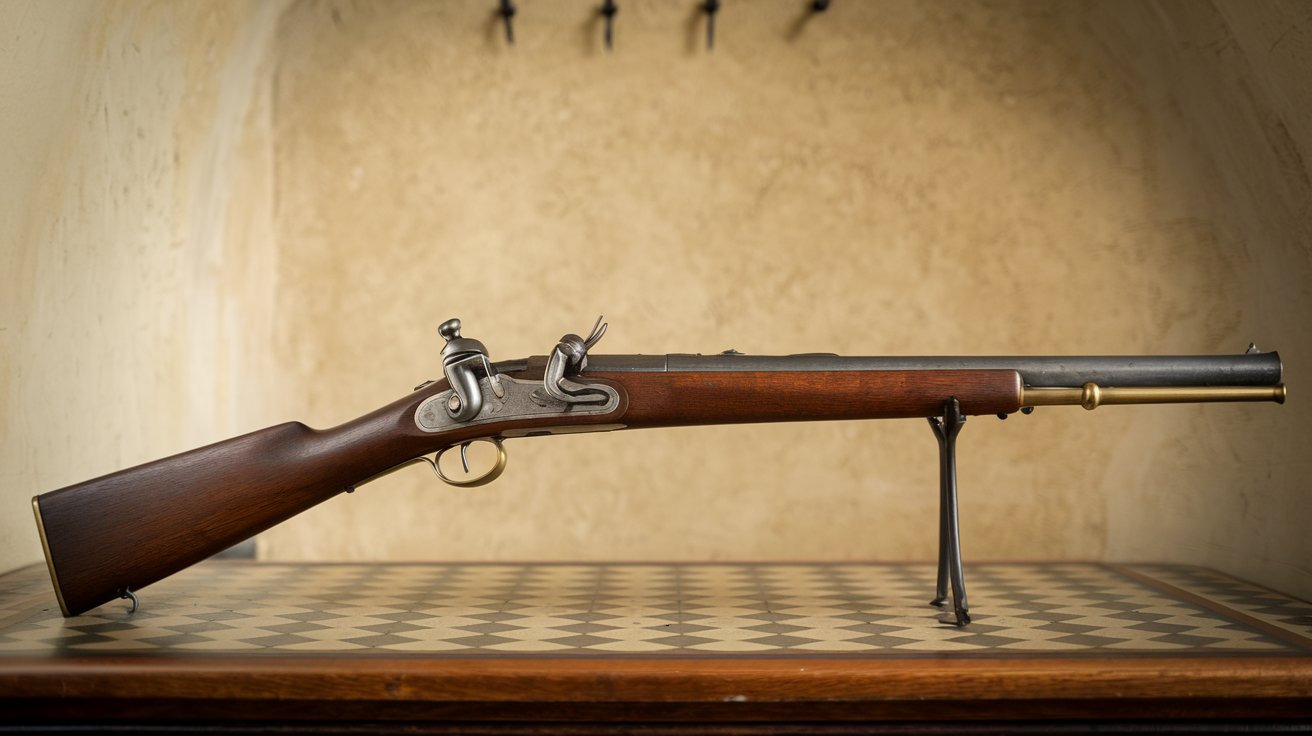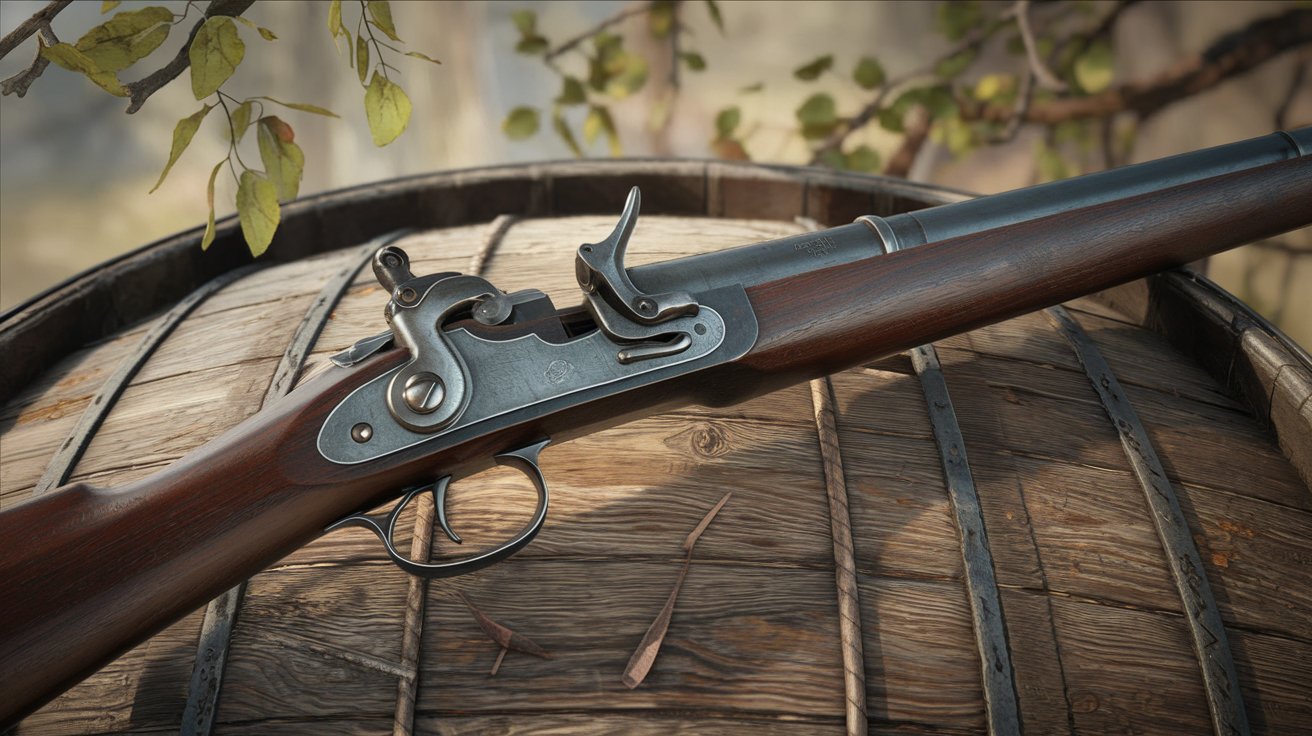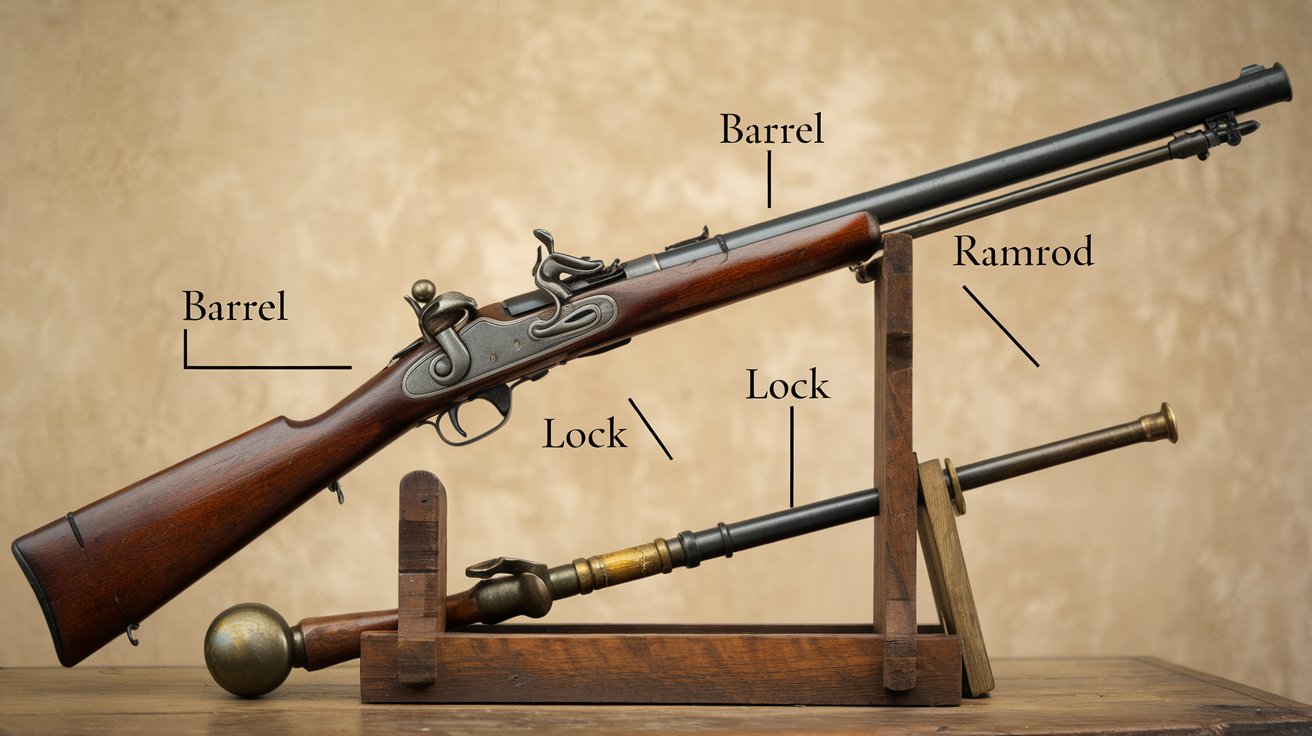
Understanding the parts of a musket reveals the engineering brilliance behind firearms that shaped warfare from the 15th through 19th centuries. A musket consists of three main assemblies: the barrel and firing mechanism, the lock system, and the wooden stock. Each component played a critical role in transforming gunpowder into projectile force. Whether examining a matchlock musket from the 1500s or a flintlock musket from the American Revolution, these fundamental parts remained remarkably consistent across centuries of military evolution.
What Are the Main Parts of a Musket
Every musket, regardless of ignition system, consists of approximately 15 to 30 individual components working in harmony. The barrel forms the most recognizable element, typically measuring 36 to 48 inches in smoothbore configuration for military models used by soldiers throughout history. The lock mechanism encompasses the firing system, while the stock provides structural support and handling surface. These three primary assemblies integrate with smaller components including the trigger guard, ramrod, barrel bands, and various metal furniture pieces.
The complexity of musket parts evolved dramatically between the first musket designs and refined flintlock systems. Early matchlock musket models featured simpler mechanisms with approximately 15 major parts, while later flintlock musket designs incorporated up to 30 precisely machined components. In 2026, museums across the United States house extensive collections showing this evolutionary progression, with the Smithsonian National Museum of American History maintaining over 400 documented musket variations displaying component differences.
The Barrel Assembly and Related Components
The musket barrel represents the most critical component, manufactured from iron or steel through forge-welding or boring processes. Military muskets used during the Revolutionary War and Civil War typically featured smoothbore barrels between .69 and .75 caliber, designed to fire a musket ball approximately 0.05 inches smaller than the bore diameter. This windage allowed soldiers to load quickly under combat stress, though it sacrificed accuracy beyond 100 yards. The barrel’s breech end connects to the firing chamber where gunpowder ignition occurs.
Attached to the barrel exterior, barrel bands (typically two or three) secured the barrel firmly to the wooden stock. The front sight, often a simple blade design, provided basic aiming capability. Near the breech, the touchhole or flash pan allowed ignition flame to reach the main powder charge. The bayonet lug, introduced widely in the late 1600s, enabled attachment of a musket with bayonet configuration, transforming the firearm into a pike-like weapon. Modern replicas manufactured in 2026 maintain these traditional dimensions for historical reenactments popular throughout the United States.
Lock Mechanisms: Matchlock to Flintlock Evolution
The lock mechanism determined how soldiers ignited the gunpowder charge, with three major systems dominating different historical periods. The matchlock musket (1450-1700) used a slow-burning match cord held in a serpentine clamp that descended into a priming pan. The wheel-lock (1500-1650) employed a spinning steel wheel striking pyrite, while the flintlock musket (1630-1850) featured a flint striking a steel frizzen to create sparks. Each system required distinct components that dramatically affected reliability, loading speed, and battlefield effectiveness for soldiers in war.
Matchlock Musket Components
The matchlock musket introduced the first practical trigger mechanism to firearms. Its lock plate mounted a serpentine arm (also called a cock) that held the slow-burning match cord. The trigger lever connected via a simple linkage to drop the glowing match into the priming pan filled with fine gunpowder. The pan cover protected the priming charge from wind and moisture. This system, while revolutionary for its era, required soldiers to maintain a constantly burning match, creating logistical challenges and battlefield vulnerabilities. Approximately 200,000 matchlock muskets saw service across European and Asian conflicts between 1500-1700.
Flintlock Musket Lock Components
The flintlock musket represented peak musket technology, dominating warfare through the Napoleonic Wars, American Revolution, and early 19th century conflicts. The lock assembly contained the hammer or cock holding a shaped flint, the frizzen (steel striking plate), the priming pan, and the internal mainspring, sear, and tumbler mechanism. When the trigger released the sear, the mainspring drove the cock forward, causing the flint to scrape down the frizzen, generating sparks that ignited pan powder. This flash traveled through the touchhole to fire the main charge. The Brown Bess musket, standard British infantry weapon, contained 27 lock components machined to precise tolerances.
Stock and Furniture Components
The wooden stock provided structural integrity and handling surface, traditionally crafted from hardwoods like walnut, maple, or beech. The stock extended from the butt plate to beyond the barrel, with the butt stock section contacting the shooter’s shoulder and the forestock supporting the barrel. Skilled craftsmen in colonial America and Europe shaped stocks through extensive hand-fitting processes, requiring 20-40 hours per musket. The wood needed sufficient density to absorb recoil forces while remaining light enough for soldiers to carry during extended marches.
Metal furniture components reinforced the stock and provided functional elements. The butt plate, typically brass or steel, protected the stock’s rear from impact damage. The trigger guard shielded the trigger mechanism while providing a forward grip point. Side plates covered lock mortises, while barrel bands (sometimes called ramrod pipes) secured both barrel and ramrod. The patchbox, common on American longrifles and some muskets, provided storage for patches and tools. Premium military muskets featured brass furniture, while economy models used iron components to reduce cost for mass military procurement.
Loading and Firing Components
The ramrod served as an essential loading tool, stored in a channel beneath the barrel. Soldiers used this rod, typically made of wood with a metal tip, to seat the musket ball and powder charge firmly against the breech. During the Civil War, trained soldiers could fire three aimed rounds per minute using standardized loading procedures, though this rate could increase to four rounds per minute for experienced troops under ideal conditions. The question of how fast could Civil War soldiers reload depends on factors including ammunition preparation, weather conditions, and combat stress levels.
The ammunition system itself comprised multiple elements. Paper cartridges contained pre-measured powder charges (typically 90-110 grains of black powder) and a lead ball weighing approximately 1 ounce. Soldiers bit open the cartridge, poured powder down the barrel, inserted the ball wrapped in paper wadding, and rammed everything tight. The priming powder, finer than main charge powder, filled the pan through a separate step. Modern reenactors in 2026 still demonstrate these loading procedures at historical sites throughout the United States, using reproduction equipment that faithfully replicates original component specifications.
Historical Evolution of Musket Parts
The first musket designs emerged in Spain around 1520, featuring heavy barrels requiring forked rests for aiming. These arquebuses weighed 15-20 pounds and measured over 5 feet in length. Early versions lacked standardized parts, with gunsmiths crafting each component individually. The question who invented the musket remains debated among historians, though Spanish and Italian armories documented production by 1520. These early firearms evolved from hand cannons used in warfare since the 1300s, with the matchlock mechanism representing the first true musket innovation.
By 1700, European militaries embraced parts standardization to enable field repairs. The French Charleville musket (1717) and British Brown Bess (1722) established patterns that influenced American firearms including the Springfield Model 1795. These flintlock musket designs featured interchangeable lock components within production batches, though true interchangeability wasn’t achieved until the American System of Manufacturing emerged in the 1820s. The Springfield Armory and Harpers Ferry Armory pioneered precision manufacturing techniques, producing muskets where any lock component fit any musket of the same model—a revolutionary concept that transformed American industrial capacity.
Specialized Musket Variations and Components
While standard infantry muskets dominated military arsenals, specialized variants incorporated unique components for specific roles. The musket pistol, a shortened cavalry weapon, featured abbreviated barrels between 9 and 16 inches, making it manageable on horseback. Naval boarding muskets included belt hooks for hands-free carrying while climbing rigging. Muskets designated for officers often incorporated higher-grade components including brass furniture, engraved lock plates, and select-grade walnut stocks.
The musket with bayonet configuration became universal by 1700, with the socket bayonet design allowing firing with the blade attached. This innovation eliminated earlier plug bayonets that inserted into the barrel, blocking firing capability. The socket bayonet’s offset design featured a triangular or spike blade, hollow socket, and locking ring, adding approximately 17 inches to the musket’s reach. American forces during the Revolutionary War relied heavily on bayonet charges, with General von Steuben’s training emphasizing this combination weapon tactic that maximized the parts of a musket for both ranged and close combat effectiveness.
Maintenance and Repair Components
Military organizations issued maintenance tools that became essential extensions of the musket system. The worm, a corkscrew attachment for the ramrod, extracted stuck loads or cleaning patches. The vent pick, a wire tool, cleared the touchhole of fouling residue that accumulated after repeated firing. Soldiers carried spare flints, typically receiving 6-12 replacements that provided approximately 50-60 shots per flint depending on quality and knapping skill.
The lock components required the most frequent replacement, with mainsprings failing after 5,000-10,000 shots and frizzens wearing from constant flint strikes. Unit armorers maintained supplies of springs, sears, and screws to keep weapons operational. During the Civil War, the Union Army established depot-level maintenance facilities that refurbished approximately 15,000 muskets monthly, replacing worn barrels, restocking damaged weapons, and standardizing components across different manufacturer variations. Modern collectors in 2026 pay premium prices for muskets retaining original parts versus those rebuilt with replacement components.
Comparing Musket Parts to Modern Firearms
Understanding musket components provides context for modern firearm evolution. While muskets required separate priming and main charges, contemporary cartridge ammunition integrates primer, powder, and projectile. The manual lock mechanism gave way to firing pins and striker systems. However, fundamental principles remain: a barrel contains pressure, a trigger mechanism releases firing energy, and a stock provides handling interface. The question addressing the best selling pistol of all time—the Glock 19 with over 10 million units produced since 1988—demonstrates how standardized parts and reliability principles pioneered in musket manufacturing still dominate firearms markets.
Modern firearm manufacturing owes substantial debt to musket-era innovations. The American System of Manufacturing, developed specifically for musket production at Springfield Armory in the 1820s, introduced interchangeable parts manufacturing that revolutionized all industrial production. Eli Whitney’s 1798 contract to produce 10,000 muskets with interchangeable components pioneered jigs, fixtures, and gauging systems still used in 2026. The precision measuring tools, quality control procedures, and assembly line concepts originated from solving problems inherent in manufacturing the many parts of a musket to military specifications.
Collecting and Identifying Musket Parts
For collectors and historians in the United States, identifying authentic musket components requires understanding manufacturer markings, proof marks, and period-correct construction techniques. Lock plates typically display maker names or armory stamps—Springfield, Harpers Ferry, or contractor marks like Eli Whitney or Simeon North. British muskets bear crown and broad arrow proofs, while French muskets show royal or republican arsenal stamps. The barrel breech area contains proof marks indicating successful pressure testing, with different nations using distinctive marking systems.
Authentication challenges arise because components were frequently replaced during service life and later refurbishment. A Civil War-era Springfield Model 1861 might contain a lock dated 1863, a barrel dated 1864, and stock cartouches from 1862. Collectors consider these “correct period” assemblages acceptable, while muskets mixing components across incompatible models or time periods face authentication concerns. In 2026, advanced metallurgical analysis, wood density testing, and digital microscopy help experts verify component authenticity, with services available through major auction houses and military museums specializing in American martial arms.
Cultural and Historical Significance
The parts of a musket tell broader stories about technological transfer, industrial development, and military doctrine. The historical question regarding what race had guns first oversimplifies complex technological diffusion patterns—Chinese inventors developed gunpowder weapons by 1000 CE, Middle Eastern forces employed early cannons by 1250 CE, and European armories produced hand-held firearms by 1350 CE. Each culture adapted and improved component designs, with Islamic, Asian, and European gunsmiths contributing innovations in barrel manufacturing, lock mechanisms, and stock configurations.
American musket production particularly influenced national development. The Springfield Armory (1777-1968) and Harpers Ferry Armory (1799-1861) didn’t merely produce weapons—they incubated manufacturing techniques that transformed American industry. The interchangeable parts concepts perfected for musket locks migrated to clock-making, sewing machines, agricultural equipment, and eventually automobile production. When Henry Ford implemented assembly line production in 1913, he built upon principles established in musket armories nearly a century earlier. Museums throughout the United States, including Colonial Williamsburg, Fort Ticonderoga, and the Springfield Armory National Historic Site, maintain extensive educational programs in 2026 demonstrating how these component innovations shaped American manufacturing supremacy.
Related video about parts of a musket
This video complements the article information with a practical visual demonstration.
FAQ – Common Questions
What are the three main parts of a musket?
The three main assemblies of a musket are the barrel assembly (including the metal tube, touchhole, and sights), the lock mechanism (matchlock, wheel-lock, or flintlock ignition system), and the stock (wooden body with metal furniture). Each assembly contains multiple sub-components that work together. The barrel typically measures 36-48 inches for military models, the lock contains 15-27 individual pieces depending on type, and the stock includes reinforcing metal parts like barrel bands, trigger guard, and butt plate. Together, these assemblies create a functional muzzle-loading firearm that dominated warfare from the 1500s through the 1860s.
How does a flintlock musket firing mechanism work?
A flintlock musket uses a hammer (cock) holding a piece of shaped flint that strikes a steel frizzen when the trigger is pulled. This impact creates sparks that fall into the priming pan filled with fine gunpowder. The flash from the pan travels through the touchhole into the barrel’s main powder charge, firing the musket ball. The mechanism includes internal components like the mainspring (providing striking force), sear (holding the hammer), and tumbler (rotating pivot). The entire process occurs in approximately 0.05 seconds. Flintlock systems proved more reliable than earlier matchlocks, functioning in wet conditions when properly maintained, and dominated military use from 1650 through 1840.
What is a musket ball and how was it loaded?
A musket ball is a spherical lead projectile typically weighing 1 ounce (approximately 437 grains) for .69 to .75 caliber military muskets. The ball measured slightly smaller than the barrel’s bore diameter, creating windage that allowed faster loading but reduced accuracy. Soldiers loaded by pouring pre-measured gunpowder down the barrel, inserting the ball wrapped in paper wadding, and using the ramrod to seat everything firmly against the breech. Civil War soldiers could complete this process and fire three aimed shots per minute with training. The paper cartridge system, introduced in the 1500s and perfected by 1700, pre-packaged powder and ball together for faster battlefield reloading.
Who invented the musket and when?
The first musket emerged in Spain around 1520, though no single inventor receives credit. Spanish armories developed the musket from earlier arquebuses by adding the matchlock firing mechanism and creating a lighter weapon that didn’t require a forked rest. The term “musket” possibly derives from the Italian “moschetto” (sparrow hawk) or “mosca” (fly). Early muskets weighed 10-15 pounds compared to 20-pound arquebuses. European gunsmiths in Spain, Italy, and Germany simultaneously improved firing mechanisms throughout the 1500s. The flintlock musket, representing peak musket technology, appeared around 1610 in France and gradually replaced matchlock systems. By 1700, standardized military musket designs dominated European armies, with patterns like the French Charleville and British Brown Bess influencing firearm development worldwide.
What components make up a musket lock mechanism?
A flintlock musket lock contains approximately 20-27 components including external parts (hammer/cock, frizzen, pan, frizzen spring) and internal mechanisms (tumbler, sear, bridle, mainspring). The mainspring, typically the strongest component, provides energy to drive the cock forward. The sear holds the cock at full or half-cock positions until the trigger releases it. The tumbler converts forward motion into rotational movement. The frizzen pivots upward when struck, exposing the priming pan while generating sparks. Quality locks required precise fitting—gaps of more than 0.005 inches between components could cause misfires. British and American military locks underwent rigorous testing, with government inspectors rejecting mechanisms failing to spark reliably after 200 consecutive strikes.
How do you maintain and clean musket parts?
Proper musket maintenance involves cleaning the barrel with hot water to dissolve black powder fouling, followed by thorough drying and light oil coating to prevent rust. The lock mechanism requires disassembly every 100-200 shots for cleaning and inspection of springs, screws, and bearing surfaces. Soldiers used the vent pick to clear the touchhole and the worm attachment to extract stuck loads. Flints needed replacement every 50-60 shots and re-knapping when edges dulled. The wooden stock requires protection from moisture and occasional oil treatment. During active service, soldiers cleaned weapons daily, with military regulations specifying maintenance procedures. Modern collectors in 2026 use museum-grade conservation techniques including climate control and archival storage materials to preserve antique musket components long-term.
| Musket Component | Primary Function | Historical Significance |
|---|---|---|
| Barrel Assembly | Contains and directs powder explosion, typically 36-48 inches smoothbore .69-.75 caliber | Forge-welding and boring techniques pioneered metal manufacturing precision |
| Lock Mechanism | Ignites powder charge through matchlock, wheel-lock, or flintlock systems | Evolution from matchlock to flintlock transformed battlefield tactics and reliability |
| Wooden Stock | Provides structural support and handling interface, absorbs recoil forces | Stock design influenced ergonomics and enabled bayonet fighting techniques |
| Ramrod | Essential loading tool for seating ball and powder charge against breech | Enabled soldiers to achieve 3-4 shots per minute reload speed in battle |
| Trigger Assembly | Releases sear mechanism to fire weapon, protected by metal trigger guard | Mechanical advantage systems improved from 1500s through 1800s refinements |
| Bayonet Attachment | Converts musket into pike-like weapon, socket design allows continued firing | Socket bayonet (1680s) eliminated need for separate pike infantry formations |